Carbon Credits 2026: A Business and Investor Guide
Anúncios
Capitalizing on Carbon Credits in 2026: A Financial Guide for Businesses and Investors
The global effort to combat climate change has never been more urgent, and at the heart of many proposed solutions lies the concept of carbon credits. As we approach 2026, the landscape of carbon markets is evolving rapidly, presenting both significant challenges and unparalleled opportunities for businesses and investors alike. Understanding the intricacies of carbon credits 2026 is not just about compliance; it’s about strategic positioning, risk management, and unlocking new avenues for sustainable growth.
Anúncios
This comprehensive guide delves into the projected state of carbon markets in 2026, offering a financial perspective for those looking to navigate this complex yet crucial environmental and economic domain. We will explore the regulatory shifts, market dynamics, technological advancements, and the strategic implications for various stakeholders. Whether you are a business aiming to reduce your carbon footprint, an investor seeking green opportunities, or a policymaker shaping the future of environmental finance, this article provides the insights you need to make informed decisions.
The Evolving Landscape of Carbon Credits in 2026
What are Carbon Credits? A Refresher for the Modern Era
Before diving into the specifics of carbon credits 2026, it’s essential to revisit the fundamental concept. A carbon credit, often referred to as a carbon offset, is a measurable, verifiable permit that allows the owner to emit one tonne of carbon dioxide equivalent (CO2e) from industrial processes. These credits are generated by projects that reduce, remove, or avoid greenhouse gas (GHG) emissions. The underlying principle is simple: polluters can offset their emissions by purchasing credits from projects that have successfully reduced emissions elsewhere.
Anúncios
In 2026, this definition remains largely consistent, but the mechanisms, verification processes, and market structures are undergoing significant refinement. The drive for greater transparency, integrity, and standardization is paramount, especially after past criticisms regarding the effectiveness and additionality of some carbon offset projects.
Key Drivers Shaping the Carbon Market in 2026
Several powerful forces are converging to shape the carbon market as we head into 2026:
- Increased Corporate Net-Zero Commitments: A growing number of corporations are setting ambitious net-zero targets, driving demand for high-quality carbon credits to offset residual emissions. This trend is expected to accelerate, making the market for carbon credits 2026 more robust.
- Regulatory Expansion and Harmonization: Governments worldwide are implementing and expanding carbon pricing mechanisms, including cap-and-trade systems and carbon taxes. There’s also a push for greater international cooperation and harmonization of standards, influenced by Article 6 of the Paris Agreement.
- Technological Advancements: Innovations in monitoring, reporting, and verification (MRV) technologies, including blockchain and satellite imagery, are enhancing the credibility and traceability of carbon credits. This technological leap is crucial for building trust in the market.
- Growing Investor Interest in ESG: Environmental, Social, and Governance (ESG) investing continues to gain traction, with institutional investors increasingly allocating capital to sustainable assets. Carbon credits, particularly those linked to verifiable impact, are becoming an attractive component of ESG portfolios.
- Supply-Side Innovations: New methodologies for generating credits, such as direct air capture (DAC), enhanced rock weathering, and advanced biochar projects, are expanding the potential supply of high-quality offsets.
Types of Carbon Markets and Their Relevance in 2026
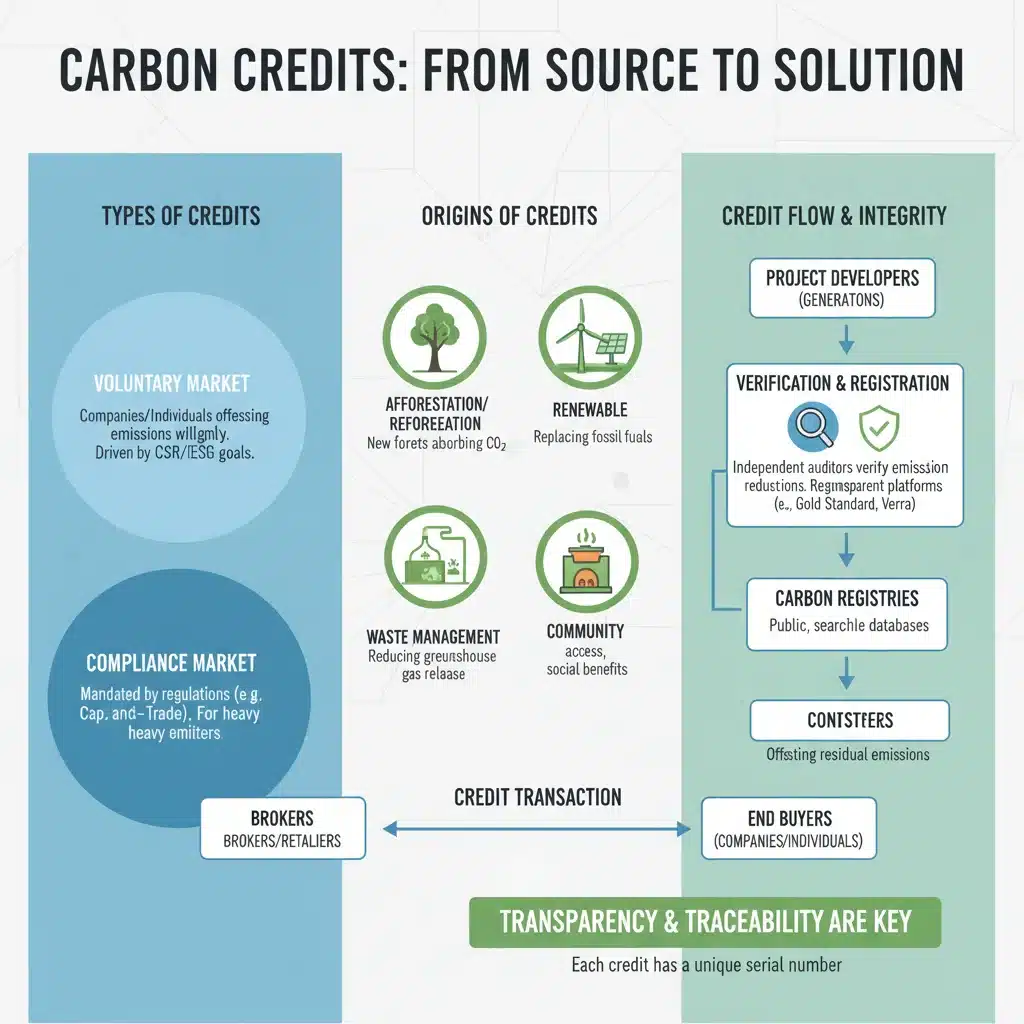
The carbon credit ecosystem is broadly divided into two main categories: compliance markets and voluntary markets. Understanding the distinctions is crucial for businesses and investors navigating the carbon credits 2026 landscape.
Compliance Carbon Markets
Compliance markets are established and regulated by governmental bodies to meet national or international emission reduction targets. Companies operating within these jurisdictions are often legally obligated to acquire and surrender carbon credits equivalent to their emissions. Key compliance markets include:
- EU Emissions Trading System (EU ETS): As the world’s largest carbon market, the EU ETS continues to be a benchmark. In 2026, it’s expected to have further expanded its scope to include new sectors and tightened its cap, leading to potentially higher carbon prices.
- California Cap-and-Trade Program: A leading example in North America, California’s program is likely to see continued stability and potential integration with other regional initiatives.
- China National ETS: The world’s largest emitter has its own national ETS, which is expected to mature and expand its sectoral coverage by 2026, significantly influencing global carbon prices and demand for carbon credits 2026.
- Emerging Markets: More countries, particularly in Asia and Latin America, are exploring or implementing their own compliance carbon pricing mechanisms, creating new regional markets and opportunities.
Prices in compliance markets are typically more volatile due to regulatory changes, economic conditions, and political decisions. However, they also offer a more stable and predictable demand base due to legal obligations.
Voluntary Carbon Markets (VCMs)
Voluntary carbon markets operate outside of regulatory mandates, allowing companies, organizations, and individuals to voluntarily purchase carbon credits to offset their emissions, achieve sustainability goals, or enhance their corporate social responsibility (CSR) initiatives. The VCM is characterized by:
- Flexibility and Innovation: VCMs often support a wider range of project types, including nature-based solutions (e.g., reforestation, regenerative agriculture) and community-based projects.
- Focus on Co-benefits: Beyond emission reductions, many voluntary credits offer significant co-benefits, such as biodiversity conservation, job creation, and improved public health.
- Increased Scrutiny and Standardization: In response to past concerns about quality and integrity, VCMs are undergoing significant reforms. Initiatives like the Integrity Council for the Voluntary Carbon Market (ICVCM) and the Voluntary Carbon Markets Integrity Initiative (VCMI) are setting new benchmarks for high-quality credits and corporate claims. This push for integrity will define the success of carbon credits 2026 in the voluntary space.
While compliance markets are driven by legal necessity, VCMs are propelled by corporate ambition, consumer demand for sustainable products, and a growing understanding of climate risk.
Financial Strategies for Businesses in 2026
For businesses, engaging with carbon credits 2026 is no longer optional; it’s a critical component of financial planning and corporate strategy. Here’s how businesses can strategically approach the market:
1. Assessing and Reducing Your Carbon Footprint
The first step is always to understand and minimize your own emissions. This involves:
- Comprehensive Emission Audits: Conducting thorough audits to identify all sources of Scope 1, 2, and 3 emissions.
- Internal Decarbonization: Investing in energy efficiency, renewable energy sourcing, process optimization, and supply chain decarbonization. The less you emit, the fewer credits you’ll need to buy.
2. Strategic Procurement of Carbon Credits
Once internal reductions are maximized, businesses can turn to carbon credits for offsetting residual emissions. The strategy for carbon credits 2026 procurement should include:
- Quality Over Quantity: Prioritize high-integrity credits from projects with strong additionality, permanence, and robust MRV. Look for certifications from reputable standards bodies (e.g., Verra, Gold Standard, American Carbon Registry).
- Diversification of Portfolio: Consider a mix of project types (e.g., nature-based, technology-based) and geographies to mitigate risks and achieve a balanced portfolio.
- Long-Term Offtake Agreements: Securing long-term agreements for future credit supply can provide price certainty and ensure access to preferred project types.
- Direct Investment in Projects: Some larger corporations may choose to directly invest in or develop carbon reduction projects, allowing for greater control over credit quality and potential co-benefits.
3. Integrating Carbon Costs into Financial Planning
Carbon prices are expected to rise. Businesses must:
- Internal Carbon Pricing: Implement an internal carbon price to incentivize emission reductions across departments and prepare for future regulatory costs.
- Scenario Planning: Model different carbon price scenarios to assess financial risks and opportunities associated with varying market conditions for carbon credits 2026.
- Reporting and Disclosure: Align with frameworks like the Task Force on Climate-related Financial Disclosures (TCFD) to transparently report on climate risks and opportunities, including carbon credit strategies.
Investment Opportunities in Carbon Credits for 2026
For investors, the carbon market in 2026 presents a dynamic and potentially lucrative asset class. The confluence of increasing demand, tightening supply, and evolving regulatory frameworks creates compelling investment theses.
1. Direct Investment in Carbon Credits
Investors can directly purchase and hold carbon credits, betting on price appreciation. This can be done through:
- Spot and Futures Markets: Participating in established exchanges for compliance credits (e.g., EU ETS allowances) or through brokers for voluntary credits.
- Carbon Funds and ETFs: Investing in specialized funds or Exchange Traded Funds (ETFs) that track carbon credit prices or invest in portfolios of credits. These vehicles offer diversification and professional management.
2. Investing in Carbon Project Developers
A significant opportunity lies in financing companies that develop and manage carbon reduction projects. These include:
- Nature-Based Solutions Providers: Companies involved in reforestation, afforestation, soil carbon sequestration, and wetland restoration. These projects often generate high-quality credits with significant co-benefits.
- Renewable Energy Developers: While many renewable energy projects are mature, there’s still potential in emerging markets or in specific technologies that generate credits (e.g., replacing fossil fuels with renewables in industrial processes).
- Innovative Carbon Removal Technologies: Investing in companies developing cutting-edge technologies like Direct Air Capture (DAC), bioenergy with carbon capture and storage (BECCS), or enhanced rock weathering. These technologies are crucial for achieving net-zero and are expected to generate premium credits in the future. The development of these technologies will heavily influence the supply and demand for carbon credits 2026 and beyond.
3. Public Equities and Green Bonds
Indirect investment opportunities include:
- Companies with Strong Decarbonization Strategies: Investing in companies that are leaders in reducing their own emissions and are strategically positioned to benefit from the low-carbon transition.
- Green Bonds: Purchasing green bonds issued by governments or corporations to finance environmentally friendly projects, some of which may generate carbon credits or reduce the need for them.
4. Understanding Risks and Returns
Like any investment, carbon credits come with risks:
- Regulatory Risk: Changes in government policies or market rules can impact carbon prices and project viability.
- Methodology Risk: The integrity and acceptance of specific carbon credit methodologies can change, affecting credit value.
- Execution Risk: Project developers may face challenges in implementing projects, leading to delays or underperformance in credit generation.
- Price Volatility: Carbon prices can be volatile, influenced by economic cycles, energy prices, and political events.
However, the potential for returns is significant, driven by increasing demand, tightening supply, and the growing mainstreaming of climate action. Investors in carbon credits 2026 should conduct thorough due diligence and consider expert advice.

The Role of Technology and Data in 2026 Carbon Markets
Technology is set to revolutionize the integrity and efficiency of carbon markets by 2026:
Blockchain for Transparency and Traceability
Blockchain technology offers a decentralized and immutable ledger for tracking carbon credits. This can:
- Enhance Transparency: Provide a clear, auditable record of credit creation, ownership, and retirement, combating issues of double-counting.
- Improve Trust: Increase confidence among buyers and sellers by ensuring the authenticity and uniqueness of each credit.
- Streamline Transactions: Facilitate faster and more secure trading of credits, reducing administrative overhead.
Advanced Monitoring, Reporting, and Verification (MRV)
Satellite imagery, IoT sensors, AI, and machine learning are transforming MRV processes:
- Real-time Data: Enable continuous monitoring of project performance, providing more accurate and timely data on emission reductions.
- Automated Verification: Reduce the reliance on manual audits, making verification more cost-effective and scalable.
- Enhanced Accuracy: Improve the precision of emission measurements, strengthening the scientific basis of carbon credits.
These technological advancements are critical for addressing past criticisms of carbon markets and building a more robust and trustworthy system for carbon credits 2026.
Navigating Article 6 of the Paris Agreement in 2026
Article 6 of the Paris Agreement provides a framework for international cooperation on emission reductions, including mechanisms for countries to transfer carbon credits (known as Internationally Transferred Mitigation Outcomes, or ITMOs). By 2026, the rules governing Article 6 are expected to be more fully implemented, with significant implications:
- New Market Mechanisms: Article 6.2 allows for bilateral cooperation and the transfer of ITMOs between countries, while Article 6.4 establishes a new UN-supervised mechanism for generating and trading credits.
- Avoidance of Double Counting: Robust accounting rules are being put in place to ensure that emission reductions are only counted once, either by the host country or the acquiring country. This is a critical factor for the integrity of carbon credits 2026 at an international level.
- Impact on Voluntary Markets: The implementation of Article 6 could influence the voluntary market by providing a clearer pathway for high-quality projects to generate internationally recognized credits.
- Increased Demand and Supply: As countries operationalize their Nationally Determined Contributions (NDCs) under the Paris Agreement, the demand for ITMOs and other Article 6 credits is expected to rise, creating new supply-side opportunities for project developers.
Businesses and investors engaging in international carbon projects must pay close attention to the evolving rules of Article 6 to ensure compliance and maximize the value of their credits.
Challenges and Opportunities for Carbon Credits 2026
Key Challenges
- Integrity and Trust: Maintaining and enhancing the integrity of carbon credits remains a perennial challenge, requiring continuous improvement in standards and verification.
- Price Volatility: Market prices can fluctuate significantly, creating uncertainty for long-term planning and investment.
- Supply-Demand Imbalance: The rapid increase in corporate net-zero commitments could outpace the supply of truly high-quality, verifiable carbon credits.
- Greenwashing Concerns: The risk of companies making misleading claims about their climate action (greenwashing) could erode public and investor confidence.
Emerging Opportunities
- Innovation in Carbon Removal: Significant investment and technological breakthroughs are expected in carbon removal technologies, leading to new classes of premium credits.
- Nature-Based Solutions: The recognition of the critical role of ecosystems in carbon sequestration will drive demand and investment in nature-based projects, particularly those with strong biodiversity and community co-benefits.
- Standardization and Harmonization: Efforts to standardize methodologies and reporting will make the market more transparent and accessible, attracting broader participation.
- Integration into Broader Financial Markets: Carbon credits are increasingly being integrated into traditional financial products and services, such as derivatives, insurance, and lending, broadening their appeal to institutional investors. The sophistication of financial instruments around carbon credits 2026 will be a key indicator of market maturity.
Conclusion: A Strategic Imperative for a Sustainable Future
The year 2026 stands as a pivotal moment for the global carbon credit market. It is a period of accelerated growth, increased scrutiny, and profound innovation. For businesses, engaging with carbon credits 2026 is not merely a compliance task but a strategic imperative that can drive competitive advantage, attract capital, and build resilience in a climate-constrained world.
For investors, the carbon market offers a unique opportunity to generate financial returns while contributing to global sustainability goals. However, success will hinge on careful due diligence, a deep understanding of market dynamics, and a commitment to investing in high-integrity projects and transparent platforms. The drive for high-quality, verifiable credits will differentiate market leaders from laggards.
As governments, corporations, and individuals increasingly commit to net-zero ambitions, the demand for effective and credible mechanisms to reduce and offset emissions will only intensify. By understanding and strategically engaging with the evolving landscape of carbon credits 2026, businesses and investors can play a critical role in shaping a more sustainable and prosperous future for all.
The journey towards a low-carbon economy is complex, but the carbon credit market, with its inherent mechanisms for valuing emission reductions, provides a powerful tool to accelerate this transition. Staying informed, adaptable, and committed to integrity will be key to unlocking its full potential.